5S Training – 5S Course to Improve Production Efficiency and Practical Workplace Performance
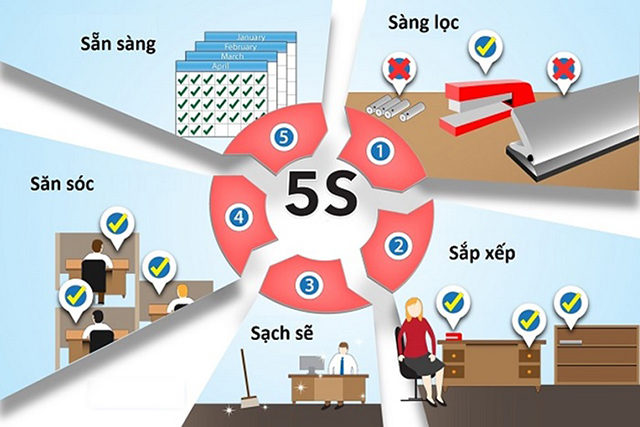
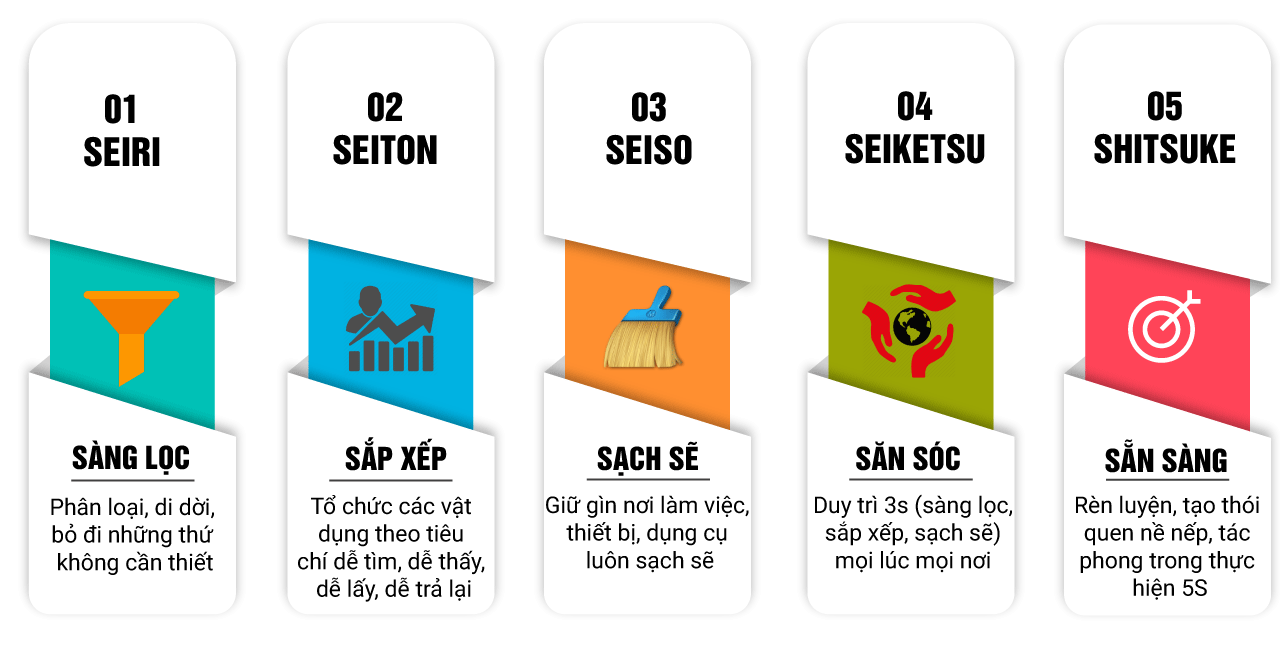
5S Training is a workplace management system, named after a series of steps starting with the letter S: Seiri (Sort), Seiton (Set in order), Seiso (Shine), Seiketsu (Standardize), and Shitsuke (Sustain).
- Implemented nationwide
- 24/7 support
- Experienced, friendly, and dedicated experts
GENERAL INTRODUCTION TO THE 5S TRAINING COURSE
5S originated in Japan in the early 1980s and has been widely applied in many countries, including Vietnam.
The purpose of applying 5S is not only to improve the working conditions and environment in an organization, but more importantly, to change the way of thinking, working habits, and to enhance the creativity of each individual in the organization.
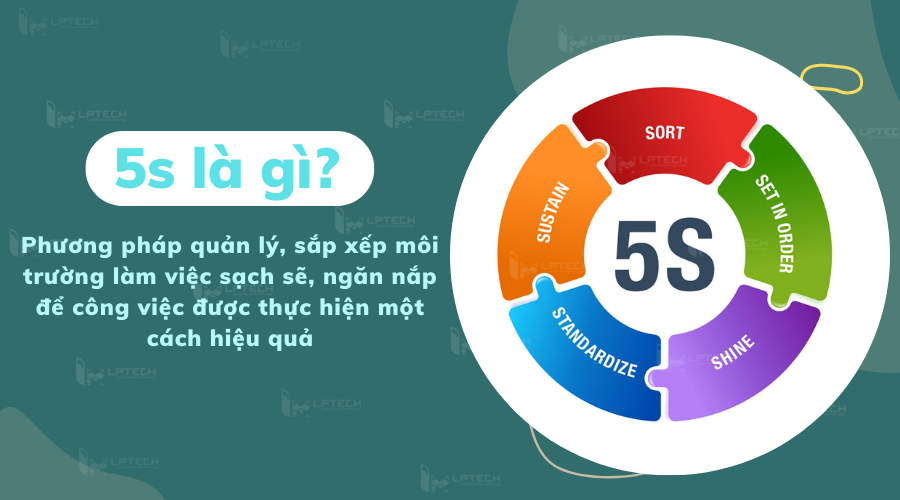
The 5S course provides guidance on the principles of workplace organization according to the 5S model, detailed evaluation content for each area, and scoring methods. Based on this material, organizations and individuals can establish specific practices and evaluation processes, as well as prepare the resources and time needed to implement workplace organization following the Japanese model.
OBJECTIVES OF THE 5S COURSE
– Improve skills in effectively organizing workplace practices with 5S
– Practice workplace organization in business offices, production areas, warehouses, showrooms, and surrounding areas.
– Practice enterprise self-assessment of 5S implementation
TARGET PARTICIPANTS OF THE 5S TRAINING COURSE
– Department heads, senior staff in internal audit
– Department heads, senior staff in finance and accounting
– Heads of other departments with little or no experience in internal control
– Other interested individuals
PROGRAM CONTENT OF THE 5S TRAINING COURSE
Part I. Principles of Effective 5S Practices
– Introduction to 5S and its benefits:
1. SEIRI – Sort;
2. SEITON – Set in order;
3. SEISO – Shine;
4. SEIKETSU – Standardize;
5. SHITSUKE – Sustain.
– Group practice with real-life scenarios
Part II. The Role of Leadership
– Participation of everyone
– Teamwork – Visual management – Continuous learning and improvement
– Group practice with real-life scenarios
Part III. Steps to Implement a 5S Program
– Preparation – Official announcement of the 5S program by leadership
– General cleaning – Initial sorting – Daily practice of Seiri, Seiton, and Seiso
– Periodic evaluation of 5S implementation
– Group practice with real-life scenarios
Part IV. General Requirements for Implementing 5S
– Office areas
– Production/service areas – Warehouse areas – Common areas (canteen, reception/meeting rooms, etc.)
– Surrounding areas (security office, parking, etc.)
– Group practice with real-life scenarios
Final Part. Action Plan
– Guidance on applying lessons into practice
– Action plan
(The above program content may be adjusted to suit the actual needs of the business)
TEACHING METHODS OF THE 5S TRAINING COURSE
The 5S class is divided into small groups of learners for discussion and sharing. The training method emphasizes learner-centered approaches through case studies, video clips, and games…
The method does not focus on rigid theory. Trainers present theory briefly, while learners are encouraged to actively participate in short exercises. After each group presentation, trainers provide feedback to adjust solutions and summarize key lessons by topic.
Trainers use the following methods to deliver the course content:
i. Open discussion
ii. Case study
iii. Self-assessment
iv. Mini-lecture on practical topics
CASE STUDIES AND 5S SELF-ASSESSMENT
In the 5S training course, trainers will provide several 5S case studies, and learners will participate in discussions on how to approach each situation. These scenarios help learners reinforce knowledge and learn how to apply lessons in real situations. In addition, there are multiple-choice quizzes and Q&A sessions, including:
– Case studies
– Questions & answers
– Planning worksheets
– Toolkits & checklists